Marche
Why Visit
Marche is often called "the undiscovered Tuscany" but that undersells it. The region has its own distinct identity: a chain of medieval hilltop towns cascading down to a long Adriatic coastline, backed by the Sibillini mountains. Unlike Tuscany or Liguria, Marche sees remarkably few international tourists, meaning prices are lower, crowds are thinner, and the culture you encounter is genuinely local.
Best Towns & Cities
Urbino
A Renaissance jewel perched on a hill, Urbino is the birthplace of Raphael and home to the Palazzo Ducale, one of Italy's finest Renaissance palaces. The town is a living university city rather than a museum, so it has a lively atmosphere without feeling staged. The surrounding countryside of rolling green hills is stunning in every direction. Note that Urbino is not on the rail network; it is reached by bus from Pesaro (about 40 minutes).
Walking: Palazzo Ducale ↔︎ Raphael's house ~300 m. Bus from Pesaro drops at edge of centre; taxi can get closer.
Getting there: No rail station. Bus from Pesaro (~40 min); Pesaro has direct IC/Frecce service on the Bologna--Ancona line.
Ascoli Piceno
One of Italy's most beautiful piazzas, Piazza del Popolo, anchors this travertine-built medieval city. Ascoli feels genuinely undiscovered by mass tourism. It is the birthplace of olive ascolane (stuffed fried olives) and has a strong local food culture. The surrounding Tronto valley and Sibillini foothills are excellent for day trips. Reachable by train on the Adriatic line with a connection inland from San Benedetto del Tronto.
Market: Wednesday and Saturday mornings on Piazza Arringo.
Walking: Piazza del Popolo ↔︎ Piazza Arringo ~200 m.
Getting there: Regional train from San Benedetto del Tronto (~30 min), where you change from IC/Frecce services on the Adriatic line.
Coastal gateway — San Benedetto del Tronto: the change-point for Ascoli. Palm-lined promenade, broad sandy beaches, good seafood restaurants along the waterfront. Worth a half-day beach stop on the way inland. Walking: palm-lined seafront promenade; beach clubs with chair-to-sea service.
Offida
A tiny hilltop town in the southern Marche known for its lace-making tradition, a beautiful Romanesque church (Santa Maria della Rocca), and panoramic views over vineyards. Offida is in the heart of the Rosso Piceno wine country. Not on the rail network but easily reached from Ascoli Piceno or San Benedetto del Tronto.
Walking: main street loop ~400 m.
Getting there: No rail station. Bus from San Benedetto del Tronto or Ascoli Piceno (~30 min each), or by car.
Fermo
A lesser-known provincial capital with a striking hilltop cathedral, underground Roman cisterns, and sweeping coastal views from the Girfalco fortress. Fermo has an authentic small-city atmosphere and serves as a good base for exploring southern Marche. Reachable by train (station at Porto San Giorgio/Fermo on the coastal line).
Market: Saturday morning market in the historic centre.
Walking: Piazza del Popolo sights within ~300 m. Station at Porto San Giorgio (15 min taxi up to centre).
Getting there: Porto San Giorgio/Fermo station is on the Adriatic IC line; from there bus or taxi ~15 min up to Fermo's hilltop centre.
Pesaro
A cultured seaside city that was the Italian Capital of Culture in 2024. Birthplace of Rossini, hosts annual opera festival in August. Refined, palace-and-museum heavy, pedestrianised core. Honest take from a Reddit r/howislivingthere local: "a cute mid sized town that turns into a beach resort in summer. Life is fine, nothing spectacular but functional. Chill friendly vibe... it's still smallish and not that open minded." Calm evenings, good cycling infrastructure, decent restaurants. Better as a base for Urbino/Gradara day trips than as a destination in itself.
Beaches:
Spiaggia Libera Sottomonte (4.5★ / 614 Google reviews) — standout free beach for the area, ~3 km south of centro between Pesaro and Fano. Sandy, clear water, occasional jellyfish, intermittent free WiFi. Access via small tunnel under the rail tracks; parking along the road. Bike path connects directly from Pesaro. Recurring praise: "hidden gem", "THE BEST BEACH IN TOWN AND IS FREE!" Dogs not allowed. Needs e-bike, scooter, taxi, or short train hop to reach.
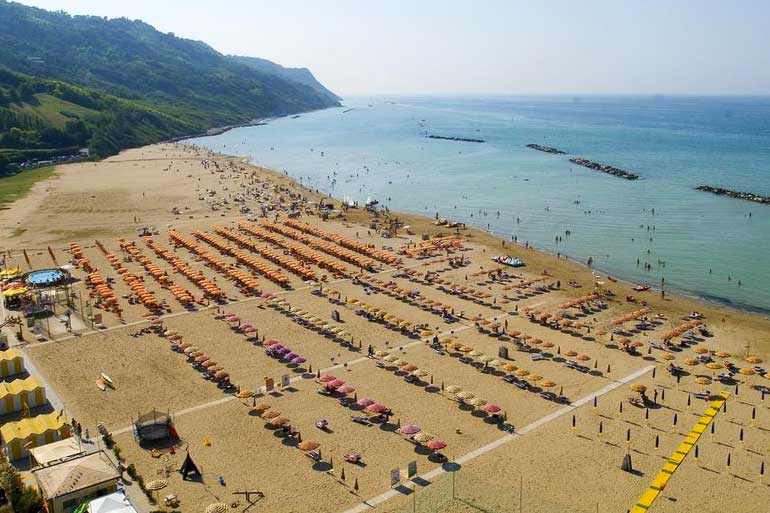
Lungomare beach clubs — standard club-and-umbrella strip closer to centro, walkable from town but less highly rated than Sottomonte.
Market: daily covered market (Mercato di Via Branca).
Walking: centro ↔︎ lungomare ~500–700 m; centro ↔︎ Sottomonte beach ~3 km (e-bike, taxi, or train hop to Fano).
Getting there: Direct IC/Frecce station on the Bologna--Ancona line (~1 h from Bologna).
Fano
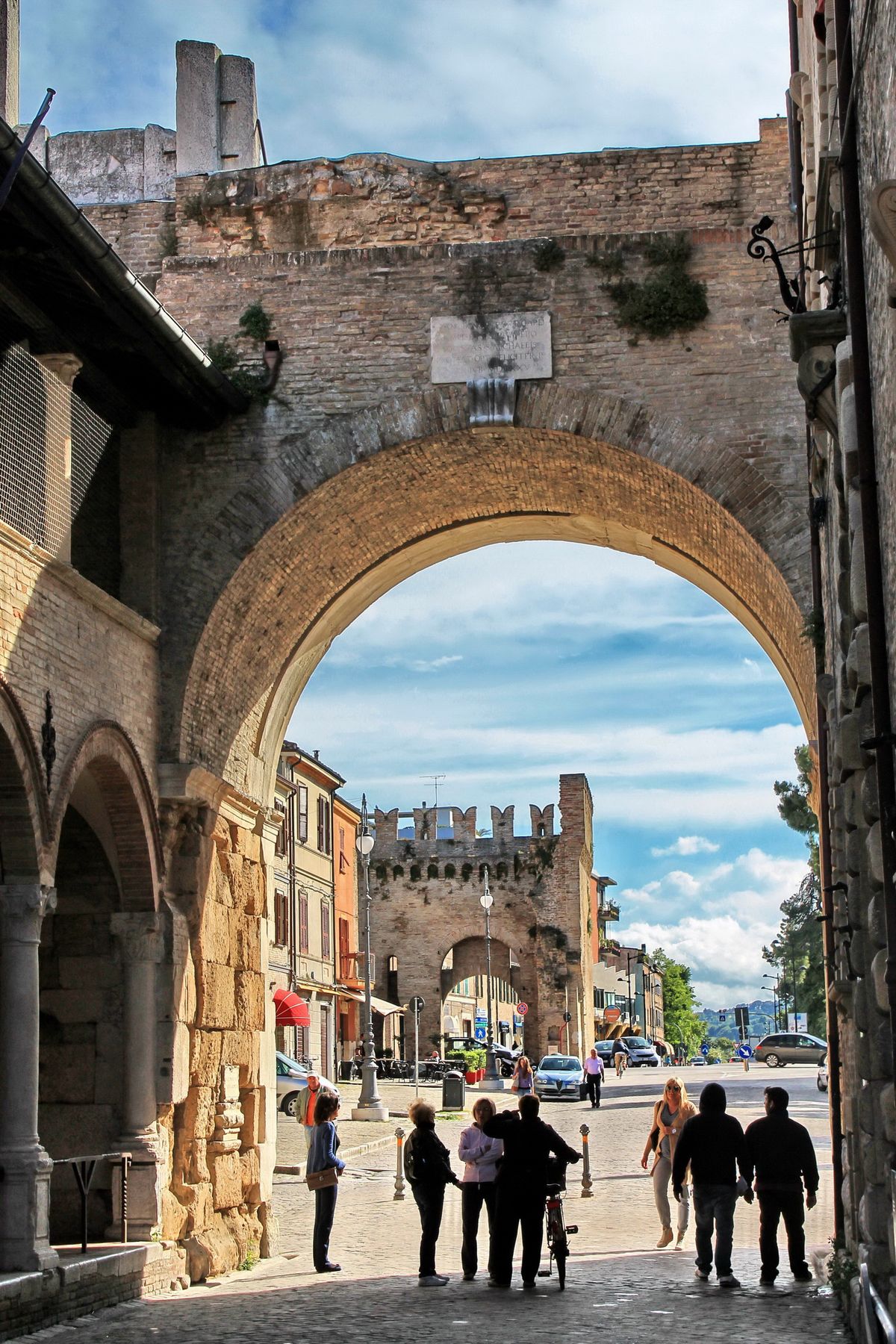
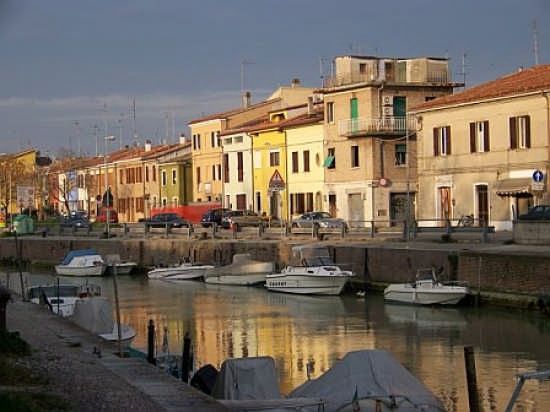
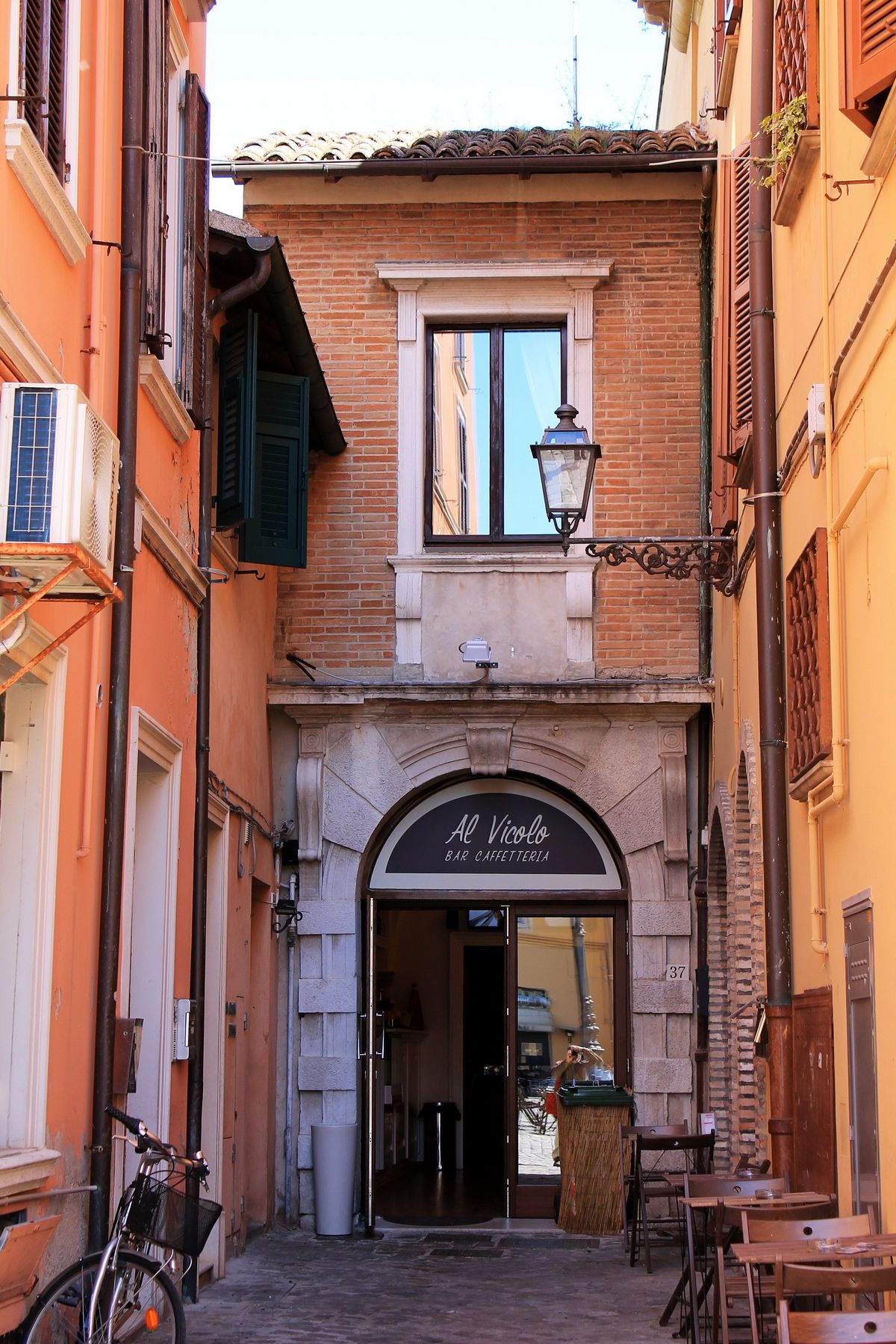
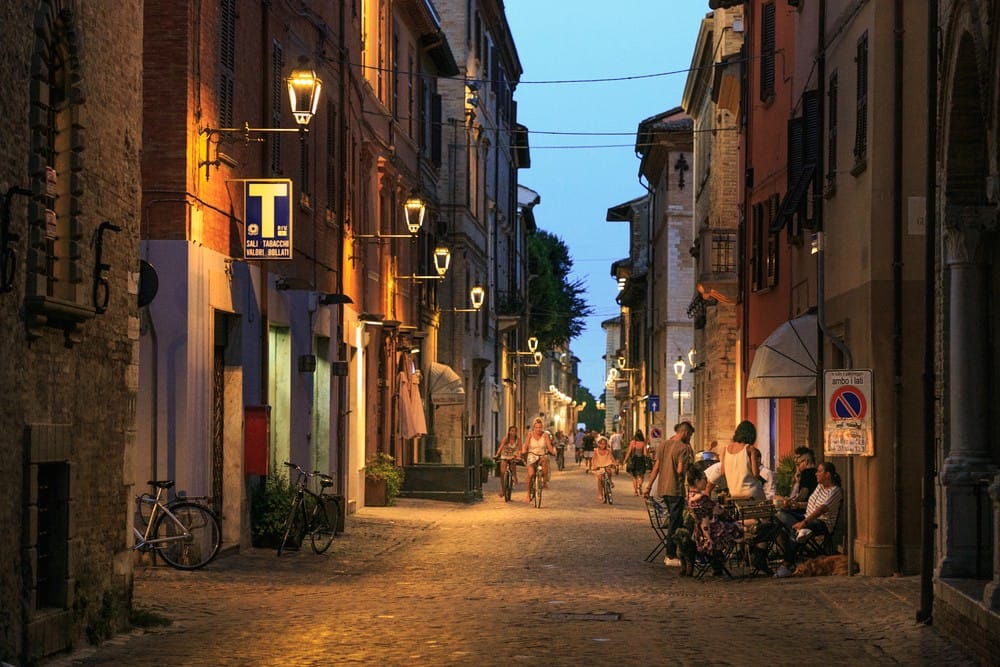
12 km southeast of Pesaro, medieval walled town with Roman roots (Arco d'Augusto, 9 AD — the largest Roman settlement on the Adriatic). Described by Italian sources as "the liveliest, most cheerful and modern city in all of northern Marche". Local-preferred over Pesaro for atmosphere — Saturday market, summer jazz festival, vibrant lungomare. Stronger food reputation: cucina fanese is its own school of Adriatic cooking, the definitive brodetto fanese recipe is from here. Population ~60k. The Carnevale di Fano (oldest in Italy, 1347) runs January–February — not on our June dates, but the town has summer programming.
Beaches:
Lido di Fano (4.4–5★ / 441 reviews, Blue Flag) — sandy beach north of port, ~500–700 m from Piazza XX Settembre. Very shallow for a long stretch, ideal for small children. Higher density of equipped family clubs.
Sassonia (4.4★ / 811 reviews, Blue Flag) — pebble beach 2 km long, just south of port, ~500–700 m from Piazza XX Settembre. Deeper water from ~5 m out, waves children enjoy. Beach clubs with restaurants and lifeguards along most of the strip; small free public sections exist. Tourist parking restrictions fine non-local cars — go on foot from centro or use the rail station.
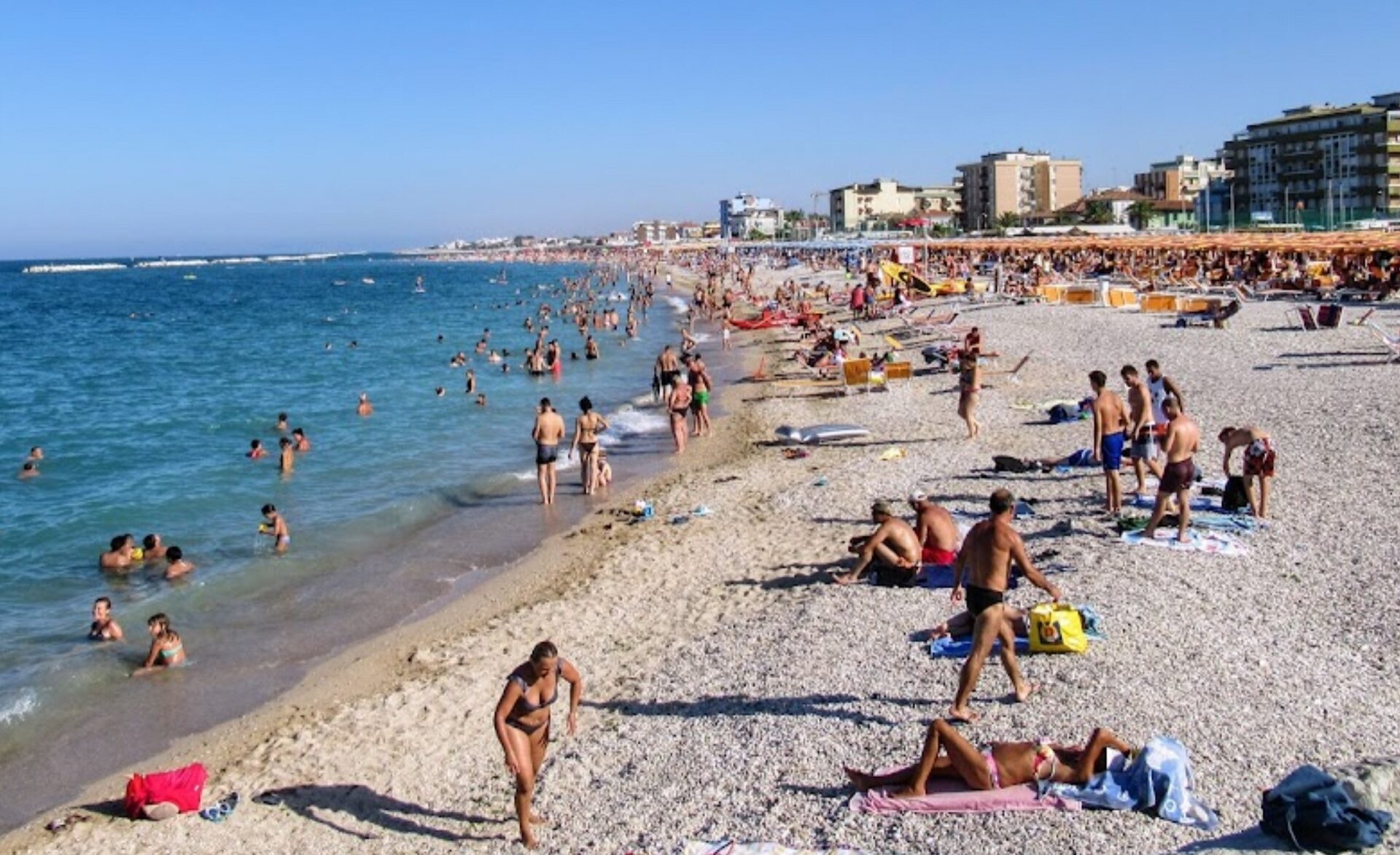
Spiaggia Libera Sottomonte (4.5★ / 614 reviews) — top-rated free beach for the area, ~9 km north toward Pesaro. Reach via short train hop one stop north (Pesaro station, then 3 km bike path or taxi), or by e-bike/scooter from Fano directly. Best beach on this stretch of coast — worth the half-day trip.
Walking: walled centre ~500 m across; centro ↔︎ Lido (sand) and centro ↔︎ Sassonia (pebbles) ~500–700 m each. Train station at south end of centro. Sottomonte beach ~9 km north — short train hop to Pesaro + bike/taxi, or e-bike direct.
Getting there: Regional train from Pesaro ~10 min, IC services also stop. Adriatic line.
Senigallia
The "Velvet Beach" town. Centro has the Rocca Roveresca (Della Rovere fortress) and a small Renaissance core. Two of Italy's best seafood restaurants (Uliassi and Madonnina del Pescatore — both Michelin) sit just outside town. The Fiera di Sant'Agostino market is late August, outside trip window. Quieter and more residential than Fano + Pesaro — beach is the main draw.
Beach — Spiaggia di Velluto ("Velvet Beach", free public section 4.3★ / 267 reviews) — famously fine golden sand, shallow water, lifeguarded, free showers, good lungomare food (pizzerias and seafood kiosks). Restroom complaints recur. The free strip is squeezed between paid beach clubs.
Walking: centro–Rocca–beach via continuous lungomare with frequent benches.
Getting there: Regional train ~30 min south of Pesaro. Also IC stop.
Ancona
The regional capital is not a classic beauty, but the old town on the headland has character, the cathedral perch offers sweeping Adriatic views, and it is the main rail hub for the region. The Conero Riviera just south is the real draw. Ancona is a stop on the main Adriatic rail line and is reachable by fast trains from Bologna and Milan.
Beaches — Conero Riviera (south of Ancona, accessed via car or bus from Ancona/Sirolo/Numana). Monte Conero is a limestone headland where the otherwise low-lying coast erupts into cliffs and coves:
- Spiaggia delle Due Sorelle — iconic white-pebble beach beneath twin rock stacks, accessible only by boat from Numana. The signature image of the Marche coast.
- Portonovo — beautiful bay with crystal-clear water, backed by forest. Mix of free and private beach areas. Parking close to sand.
- Sirolo — charming clifftop village with access to smaller coves below (Spiaggia di San Michele, Spiaggia Urbani). Note: the descent paths from Sirolo down to these coves are >500 m each way — better reached by the Numana shuttle boat.
Walking:
- Ancona: centro storico to cathedral involves the climb up the headland. Station has taxi rank.
- Conero coast: Portonovo has parking close to sand. Sirolo descents to San Michele/Urbani >500 m each way — better via Numana shuttle boat. Due Sorelle boat-only.
Getting there: Major IC/Frecce station with direct services from Bologna (~2 h), Milan (~3 h), and Rome (~3.5 h). Rental car or taxi recommended for Conero beach access.
Food & Drink
Marche is one of Italy's most rewarding food regions, with dishes that remain stubbornly local.
- Olive ascolane -- large green olives stuffed with meat, breaded, and deep-fried. Originally from Ascoli Piceno, found everywhere in the region.
- Brodetto -- an Adriatic fish stew with as many variations as there are coastal towns. Versions from Fano, Ancona, San Benedetto, and Porto Recanati each claim to be the original.
- Vincisgrassi -- the Marche version of lasagna, richer and more intensely flavoured than the Emilian original, sometimes made with offal or wild mushrooms.
- Ciauscolo -- a soft, spreadable salami from the inland hills, eaten on bread. Unique to Marche and parts of Umbria.
- Maccheroncini di Campofilone -- an ultra-thin egg pasta from the town of Campofilone, somewhere between tagliolini and angel hair.
- Cheese -- Pecorino dei Sibillini and Formaggio di Fossa (aged in pits) are the standouts.
Wine
Verdicchio dei Castelli di Jesi is the star white -- crisp, mineral, and one of Italy's best-value quality whites. Rosso Conero (Montepulciano grape) and Rosso Piceno are the key reds. The Offida DOCG area produces interesting Pecorino (the grape, not the cheese) whites.
Coast & Water
The Marche coastline stretches over 170 km along the Adriatic. Most beaches are long, sandy, and gently shelving, with the dramatic exception of the Conero coast (cliffs and coves — see Ancona above). Specific beaches are listed under their nearest town in the section above.
Water temperature: Adriatic sea temperatures in late June typically range from 22--24 degrees C, rising through July. Comfortable for swimming from mid-June onward. The Adriatic is generally calmer and warmer than the Tyrrhenian side at this time of year.
Getting Around
Arriving by Train
The main Adriatic rail line (Bologna - Rimini - Pesaro - Fano - Senigallia - Ancona - and south to Pescara/Bari) runs along the coast and is well covered by both regional trains and Frecce (high-speed) services. Key journey times:
- Bologna to Ancona -- approximately 2 hours by Frecciargento or Frecciabianca, frequent departures
- Bologna to Pesaro -- approximately 1 hour by fast train
- Milan to Ancona -- approximately 3 hours by Frecce (via Bologna)
- Rome to Ancona -- approximately 3-3.5 hours, with a change at Foligno or via Falconara
All these are Interrail-eligible Trenitalia services. Seat reservations are required on Frecce trains (typically 10 EUR).
Within the Region
- Coastal trains run frequently between Pesaro, Fano, Senigallia, Ancona, and points south. Journey times between neighbouring cities are 15-30 minutes.
- Inland connections are weaker. Urbino, Offida, and many hilltop towns require a bus transfer.
- The Ancona-Rome line via Fabriano crosses the interior and is scenic but slow.
- A rental car for 1-2 days is worthwhile if you want to explore the Sibillini mountains, the Conero coast, or the inland hill towns around Offida and Fermo at your own pace.
Suggested Time
3-5 days is ideal for Marche as part of a longer Interrail itinerary.
- 3 days (compact): Base in Ancona -- day trip to Conero beaches, one day exploring Ancona and Sirolo/Numana, half-day in one inland town.
- 4-5 days (recommended): Split between a northern base (Fano preferred over Pesaro for character + walkable beach access, with a day trip to Urbino) and a southern base (Ascoli Piceno or Fermo area). Include a beach day at Conero and time for unhurried meals.
- Marche pairs naturally with Emilia-Romagna to the north (train from Bologna) or Abruzzo to the south (coastal train continues to Pescara). Both transitions are smooth by rail.
The region rewards a slower pace. Evenings in the piazzas, a long lunch with vincisgrassi and Verdicchio, a morning at a near-empty Conero cove -- this is the kind of travel Marche does best.